
The load index of a tire indicates the maximum mass it can support at a given pressure. On a tire sidewall, the marking 205/55 R16 91V or 94V contains two distinct pieces of information after the dimensions: a number (91, 94) for the load and a letter (V) for speed. Confusing these two elements or neglecting the difference between 91 and 94 can pose a real safety issue, especially on a loaded vehicle.
Load per tire: what 91 and 94 actually mean
The load index is not a value in kilograms that can be read directly. It refers to a standardized table where each number corresponds to a specific maximum capacity.
A tire marked 91 supports 615 kg per tire. A tire marked 94 supports 670 kg per tire. The difference is 55 kg per wheel, or 220 kg of additional capacity for the entire vehicle.
This progression is not linear. Moving from 91 to 92 does not yield the same gain in kilograms as moving from 93 to 94. The index table follows its own curve, and adding index points to estimate the load would be a mistake. To understand the load index tire 91v or 94v, this distinction between numerical value and actual capacity remains the first reflex to acquire.
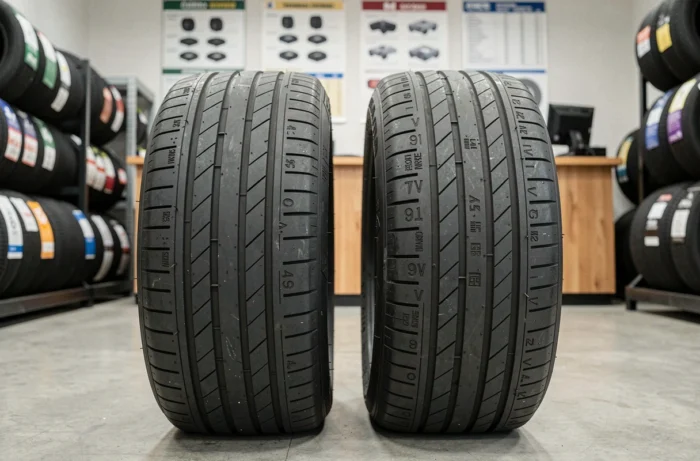
Speed index V: relationship with maximum load
The letter V after the load index designates the maximum speed at which the tire can be used continuously. On a 91V tire as on a 94V, the letter is the same: the high-speed behavior is identical.
A V index corresponds to a certified speed. Therefore, both tires share this characteristic. The difference lies exclusively in the permissible load, not in the handling at high speed.
Confusing the load index and the speed index leads to inappropriate choices. A driver who chooses a 94V thinking they will gain dynamic performance is misjudging the parameter. The gain lies in the load-carrying capacity, nothing more.
Inflation pressure and actual load: the often-ignored variable
The capacity announced by the load index (615 kg for a 91, 670 kg for a 94) is only valid at the correct inflation pressure defined by the vehicle manufacturer. An under-inflated 94V tire will not safely carry 670 kg.
Replacing a 91V tire with a 94V does not allow for an increase in the permitted load on an axle or the GVW of the vehicle. These values are set by the car manufacturer and recorded on the registration certificate. The tire is designed to comply with these limits, not to exceed them.
Check by axle, not by multiplication
The correct method is to check the maximum load permitted per axle on the registration certificate, then ensure that the tire fitment meets this requirement. Multiplying the capacity of a tire by four to obtain the total permissible load of the vehicle is a misleading approximation.
Some vehicles have different loads between the front and rear axles. An SUV or light commercial vehicle may require a higher index on the rear axle, making axle-by-axle verification necessary.
- Consult the manufacturer’s plate (on the door frame or fuel flap) for the recommended pressure and minimum load index
- Compare the maximum load per axle recorded on the registration certificate with the combined capacity of the two tires on that axle
- Never go below the load index recommended by the manufacturer, even for a better brand tire

Fitting a higher or lower index: what regulations allow
A tire with a load index higher than the original fitment is generally accepted. Moving from 91V to 94V poses no regulatory or technical issues, provided the other dimensions (width, aspect ratio, diameter) are respected.
Fitting a lower index than recommended is prohibited. A vehicle approved for 94V must not be fitted with 91V tires, even if the dimensions are otherwise identical. During technical inspection, an insufficient load index constitutes grounds for a re-inspection.
Reinforced tires and XL marking
Some tires bear the XL (Extra Load) or Reinforced marking. These tires have a reinforced internal structure that allows them to display a higher load index for the same dimension. A 205/55 R16 94V XL offers its 670 kg thanks to this specific construction.
The trade-off for an XL tire is often a higher inflation pressure to reach its nominal capacity. Inflating an XL tire to the same pressure as a standard tire of the same dimension means not utilizing its additional load capacity.
- An XL 94V tire requires the pressure indicated by the tire manufacturer, not just that of the vehicle manufacturer
- The load index of an XL tire is valid only at its specific pressure, often higher by a few tenths of a bar
- Ride comfort may be slightly firmer with a reinforced tire due to the increased stiffness of the sidewall
The difference between a 91V tire and a 94V tire comes down to 55 kg of additional capacity per wheel, conditioned by appropriate inflation pressure. The marking on the tire sidewall, the manufacturer’s plate, and the registration certificate form a sufficient verification triangle to make the right choice. A higher index is always compatible, a lower index never is.