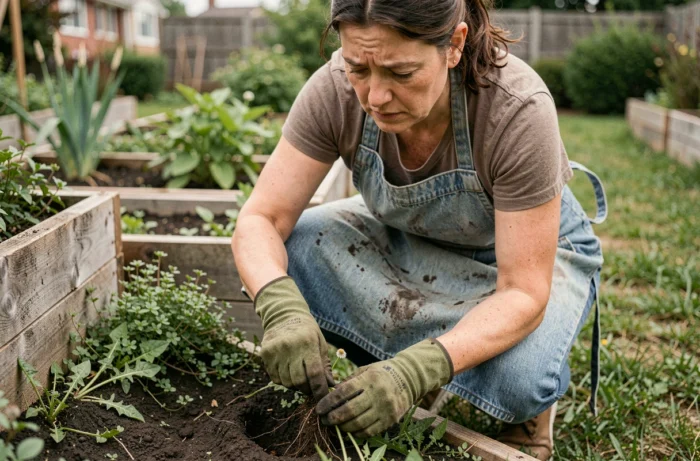
Preventing weeds from taking over a garden is not just about mulching or pulling them out. The strategy relies on an understanding of the seed bank present in the soil, the type of targeted weed, and the actual limits of each technique.
Seed Bank and Germination Dynamics of Weeds
Every square meter of cultivated land contains a reservoir of dormant seeds, sometimes viable for several decades. Tilling the soil deeply, even to prepare a flower bed, brings buried seeds to the surface and triggers their germination. We recommend limiting soil disturbance to the top five centimeters in already established areas.
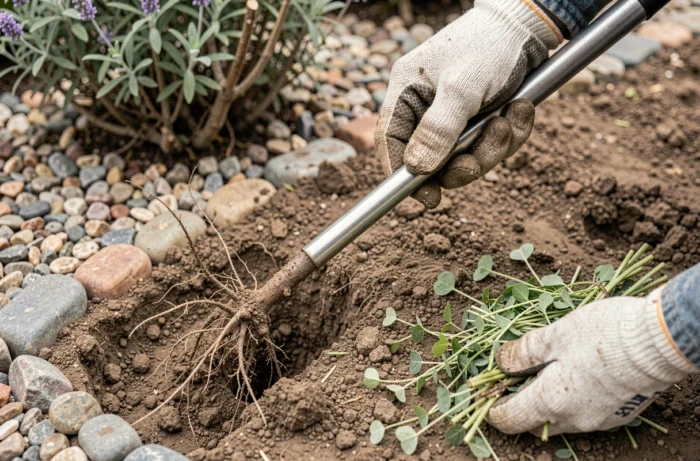
Annual weeds (chickweed, groundsel, starwort) germinate as soon as light reaches the soil surface. Perennials (bindweed, couch grass, dock) spread through fragments of rhizome or taproot. An incomplete removal of bindweed, for example, multiplies the points of regrowth instead of reducing them.
This distinction is the foundation of any coherent strategy. Complete removal works on annuals before they set seed, but it often worsens the situation with creeping perennials if the root fragments. We can find practical advice from Les Défricheurs on mechanical weeding suitable for each type of weed.
Organic Mulching vs. Woven Fabric: Rarely Mentioned Limits
Mulching remains the primary physical barrier against germination. By covering the soil, it deprives seeds of light. Not all materials are equal.
A layer of fragmented wood chips (BRF) or forest chips, laid thick enough, blocks the majority of annuals for a season. In contrast, too thin or poorly renewed mulch decomposes and becomes a substrate for germination itself. The accumulation of organic debris on the surface creates a fertile layer where seeds carried by the wind can root easily.
Woven mulch fabrics pose a similar long-term problem. Research reported by Washington State University shows that these membranes slow down weeds without permanently eliminating them. Their gradual degradation and the accumulation of organic matter on top promote recolonization. In permanent plantings (hedges, shrub beds), we regularly observe perennials breaking through the fabric after two or three years.
When Cardboard Replaces the Tarp
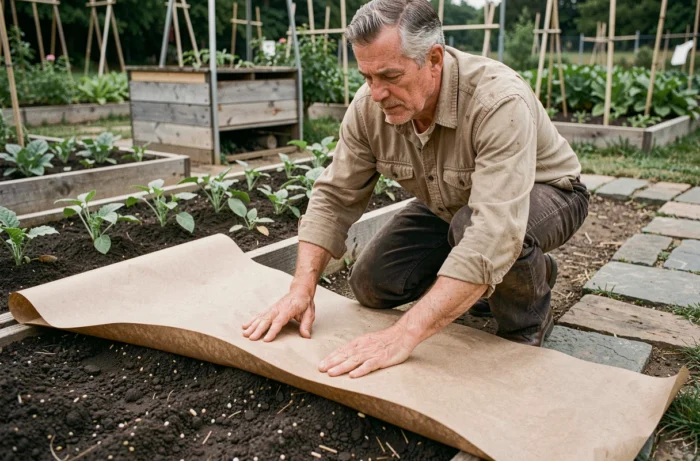
Cardboard mulching, often presented as an ecological alternative, deserves the same caution. Linda Chalker-Scott, horticulturist at Washington State University, recommends not using it around established trees and shrubs without regular maintenance. Unmonitored cardboard degrades in patches, creating bare areas where weeds establish themselves with even more vigor.
No ground cover is permanent without monitoring. Mulching reduces weeding, it does not eliminate it.
Living Ground Cover and Planting Density
The best defense against weeds is to leave them no space. In ornamental beds, high planting density and the choice of competitive ground covers drastically reduce weed pressure.
- Persistent ground covers (pachysandra, vinca minor, geranium macrorrhizum) create a dense mat that deprives the soil of light all year round, including in winter when annuals attempt to establish themselves.
- In the vegetable garden, green manures sown between two crops (phacelia, mustard, crimson clover) occupy the ground and prevent the seed bank from expressing itself. Mowing them before flowering enriches the soil without adding seeds.
- On gravel paths, a bed of compacted sand beneath the gravel, combined with a sufficiently dense geotextile fabric, slows colonization from below, while regular foot traffic limits organic deposits on the surface.
Constantly occupying the soil remains the most effective long-term strategy, ahead of any inert physical barrier.
French Regulations on Herbicides: What Has Changed for Individuals
Since January 1, 2019, the purchase, possession, and use of synthetic herbicides are prohibited for individuals in France. This ban covers gardens, vegetable patches, paths, terraces, and yards. Only biocontrol products, low-risk substances, and those permitted in organic farming remain accessible.
In practical terms, glyphosate and systemic herbicides are no longer a legal option for amateur gardeners. The authorized commercial alternatives (pelargonic acid, concentrated acetic acid) act by contact: they destroy the aerial part without affecting the roots of perennials. Their actual effectiveness is therefore limited to young annual shoots.
Weeding the Sidewalk: Check the Municipal Order
The obligation to weed the sidewalk in front of one’s home does not automatically stem from national law. It depends on a possible municipal order. Before intervening in public space, we recommend checking the rules of your municipality to avoid any unintentional violations, particularly regarding the methods used.
False Seedbed and Solarization: Soil Preparation Techniques Before Planting
The false seedbed involves preparing the soil as if for sowing, then waiting for the weeds to emerge to destroy them with a superficial pass (hoe, oscillating cultivator) before sowing the desired crop. Each false seedbed reduces the stock of viable seeds in the top centimeters.
Two to three successive passes, spaced a few weeks apart in spring or autumn, significantly reduce the pressure from annuals in the following season. This technique requires patience, but it remains the most effective way to clean a plot without resorting to any products.
Solarization, which uses a transparent tarp laid on the ground during the hottest months, destroys some seeds and young seedlings through heat. Its effectiveness varies according to sunlight and duration of exposure, but it complements a false seedbed well on a heavily infested plot.
Weed control relies on the combination of several levers, not on a single solution. Reducing soil disturbance, covering constantly (mulch or living vegetation), differentiating between annuals and perennials in interventions, and depleting the seed bank through false seedbeds: these four axes, applied together, sustainably transform weed pressure without ever promising their total disappearance.