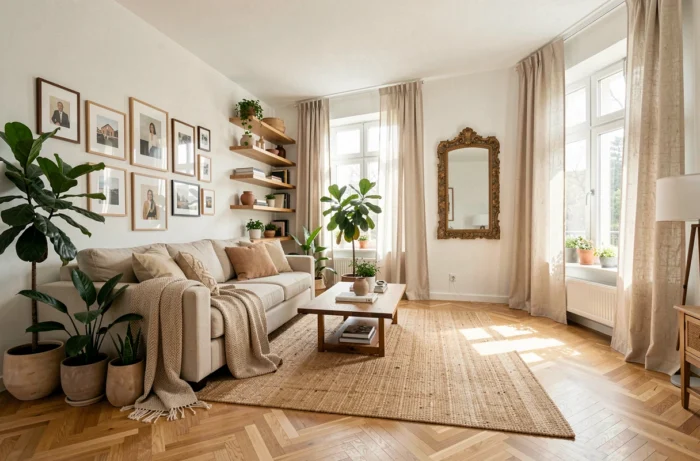
Arranging and decorating your home doesn’t necessarily require a big budget or weeks of work. Sometimes, a few targeted changes are enough to transform the atmosphere of a room. Here are 20 concrete ideas to breathe new life into your interior, from the living room to the entrance, including tips you may not have tried yet.
1. Create an asymmetrical gallery wall
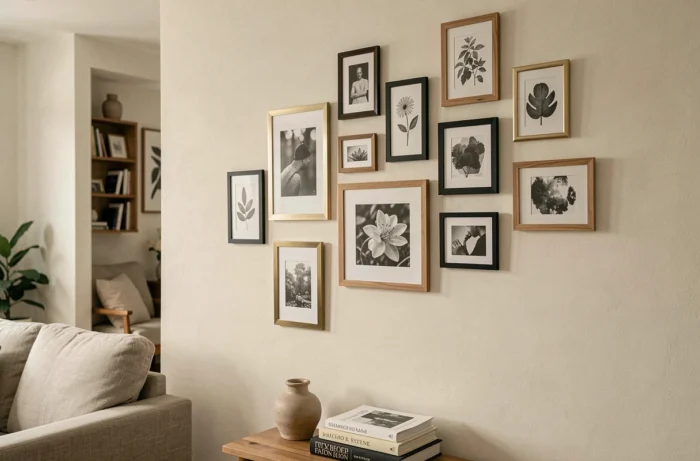
A blank wall above the sofa gives an unfinished impression. Instead of hanging a single centered painting, arrange several frames of different sizes along an irregular imaginary line.
Mix personal photos, illustrations, and even a small round mirror to break the uniformity. Asymmetry creates movement without overwhelming the room.
Many inspirations for this type of composition are available on idees-maison.com, where visual examples make it easier to put into practice.
2. Repaint a single wall in a bold color
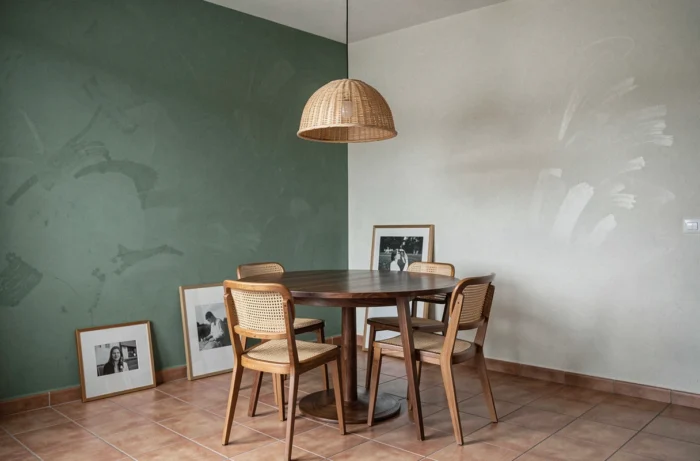
You don’t need to repaint the entire room. A single wall in a more intense shade, behind a low piece of furniture or a headboard, is enough to refocus the eye and structure the space.
Warm colors like terracotta or deep sage remain safe bets in 2026. They add depth without overwhelming a small living room.
3. Replace furniture handles
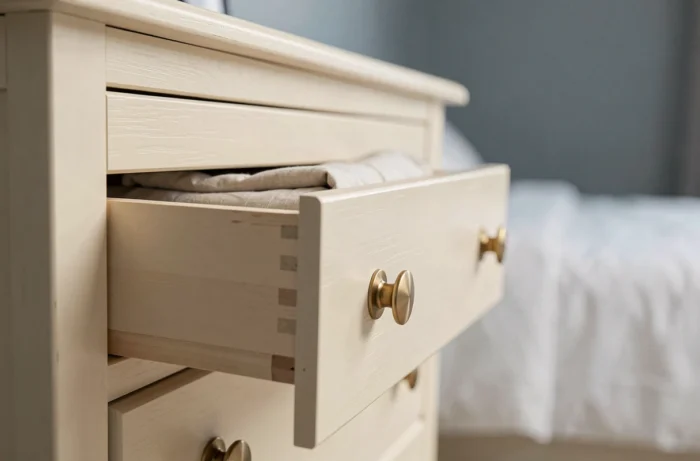
This is a detail that is often overlooked. Changing the handles on a dresser, buffet, or kitchen cabinets transforms their appearance in just a few minutes.
Brushed brass or leather handles give a more refined look to a basic piece of furniture. The cost remains modest, and no specialized tools are needed.
4. Incorporate large plants
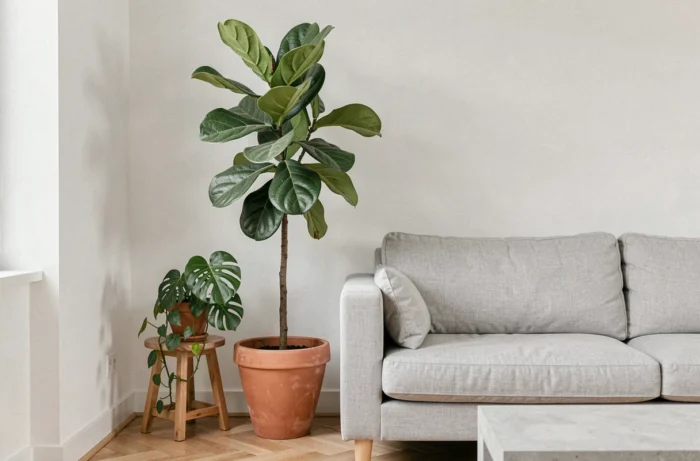
A tall plant, like a fiddle leaf fig or strelitzia, occupies an empty corner and adds volume without adding furniture. It draws the eye upward and gives a sense of height to the ceiling.
Place it near a source of natural light. A raw material planter (rattan, terracotta) enhances the decorative effect.
5. Multiply light sources
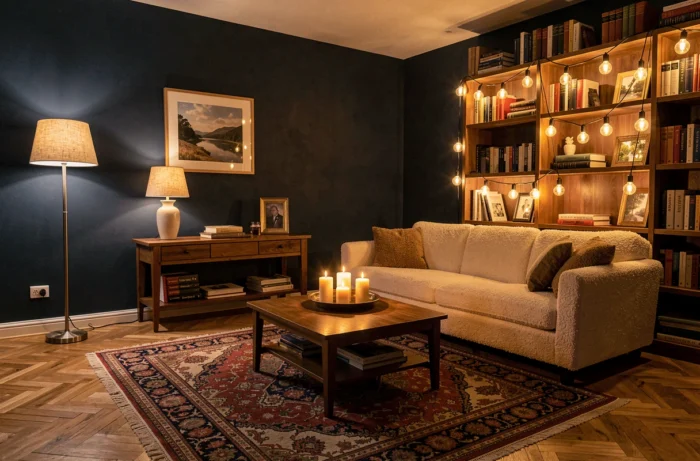
A single ceiling light creates flat and unflattering lighting. Have you noticed that welcoming interiors play with multiple light points?
Combine a corner floor lamp, a table lamp on a low piece of furniture, and possibly a discreet string of lights. Three light sources at different heights are enough to add depth to a room in the evening.
6. Repurpose a second-hand piece of furniture
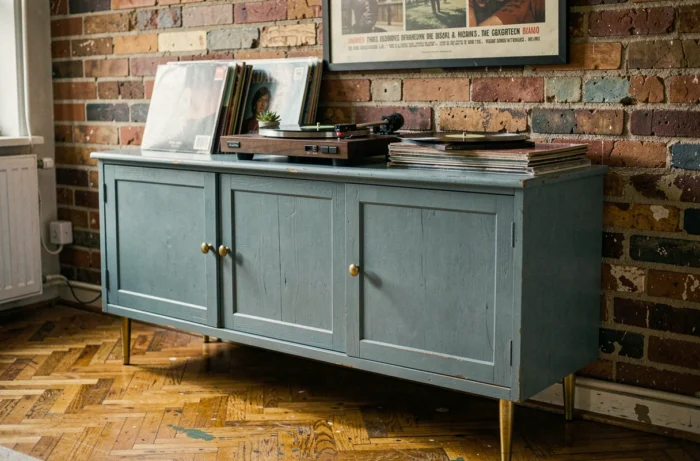
Reusing has become an aesthetic choice, not just an economic one. In 2026, designers are valuing reclaimed materials to create desirable objects.
An old workbench can serve as a vanity, and a wooden ladder can act as a towel rack. These repurposings give character to an interior and distinguish it from a catalog. The AGEC law also allows for the free pickup of your old furniture when purchasing new, making it easier to renew piece by piece.
7. Install open shelves in the kitchen
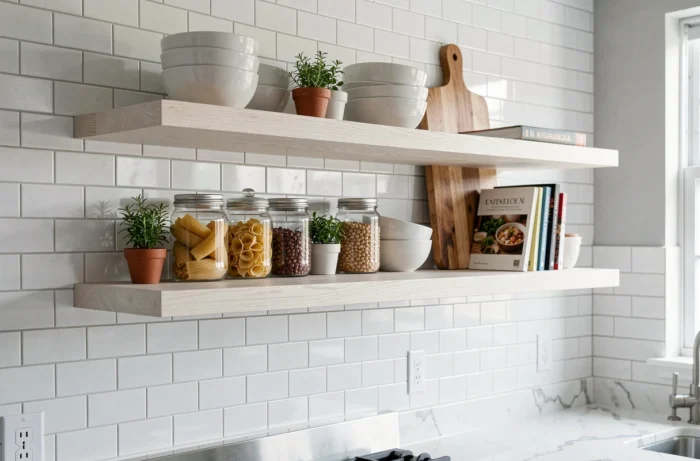
Removing one or two upper cabinets to replace them with open shelves visually lightens the kitchen. You can display your favorite dishes, a few jars, and a vase.
The trick to keeping it harmonious: limit yourself to two or three visible materials (ceramic, wood, glass). Too many colors on an open shelf create a cluttered effect.
8. Lay down a rug to define a space
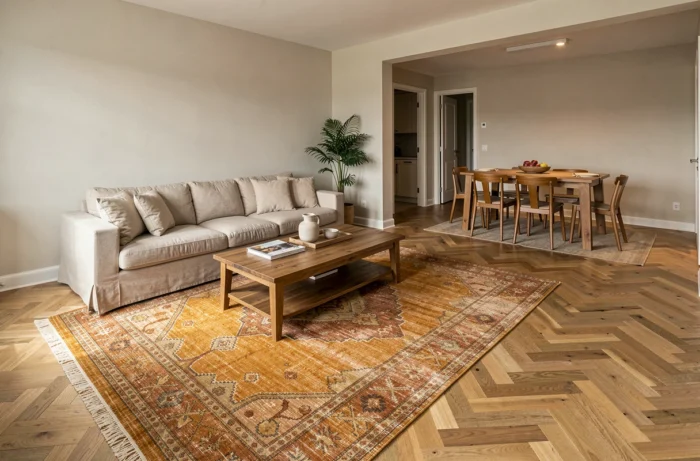
In a large living room or studio, the rug serves as an invisible frame. It defines the living area, dining area, or workspace without partitioning.
A rug slightly larger than the main piece of furniture (coffee table, desk) visually anchors the area. Prefer natural fibers like jute for a subtle look.
9. Play with the sofa textiles
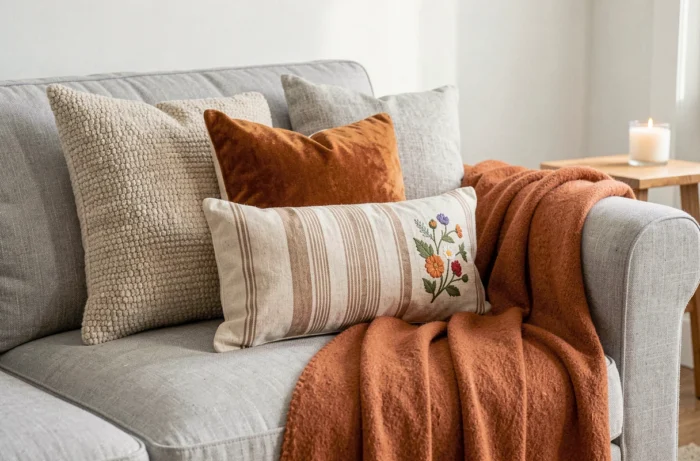
Changing the cushion covers and adding a throw costs little but changes the perception of the living room. It’s the quickest way to adapt the decor to the seasons.
In autumn, opt for corduroy or boucle wool. In spring, choose linen or washed cotton. Keep a palette of two or three colors to avoid visual cacophony.
10. Create a functional entryway even in a narrow hallway
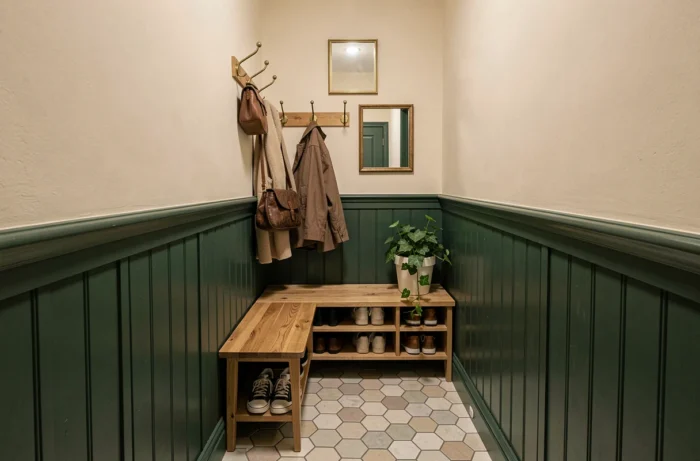
The entryway is the first impression. Even in a hallway less than a meter wide, a few hooks at different heights, a small wall-mounted bench, and a basket on the floor organize the space.
A mirror placed opposite the door visually enlarges the passage and brings in natural light.
11. Adopt a multifunctional piece of furniture
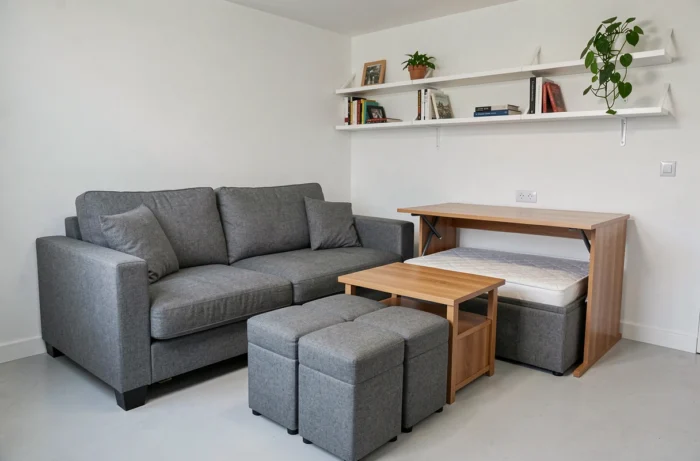
In small spaces, each piece of furniture should serve at least two functions. A coffee table with built-in storage, a storage ottoman, or a bed with drawers frees up space without sacrificing comfort.
Favor furniture with invisible storage when closed to maintain clean lines.
12. Hang curtains higher than the window
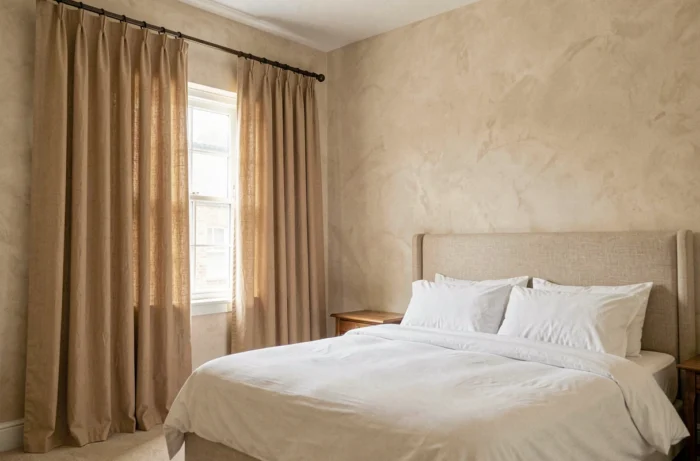
Fixing the curtain rod about ten centimeters below the ceiling, rather than flush with the window frame, visually elongates the wall. The room appears taller.
Choose curtains that touch the floor. Slightly wrinkled linen provides a natural fall and a soft texture that softens the straight lines of the furniture.
13. Opt for a panoramic wallpaper on one wall
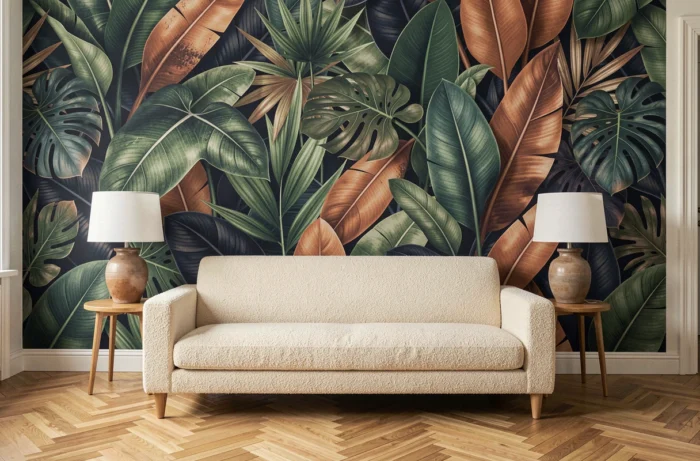
Panoramic wallpaper, applied to a single wall, acts as a giant painting. It creates depth, especially in a bedroom or closed office.
Botanical patterns or trompe-l’oeil landscapes work well in shallow rooms. Keep the other three walls in a neutral tone to allow the pattern to breathe.
14. Limit dominant materials to a maximum of three
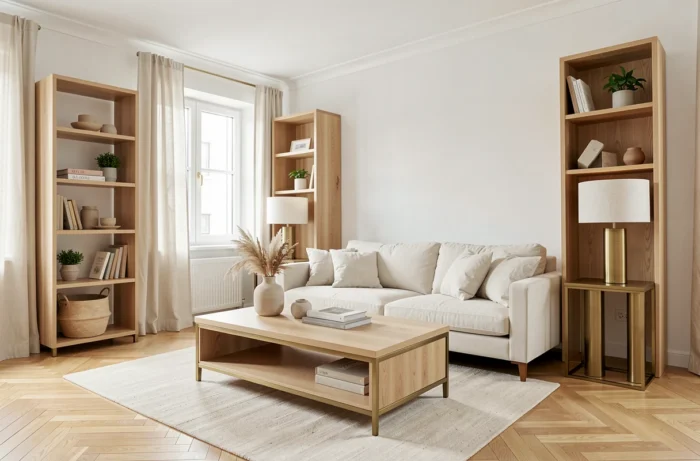
Structured interiors in 2026 move away from decorative accumulation. The principle is simple: choose three materials (for example, light wood, black metal, linen) and apply them throughout the room.
This framework prevents impulsive purchases and provides immediate visual coherence. Fewer materials, more clarity.
15. Rearrange the living room furniture layout
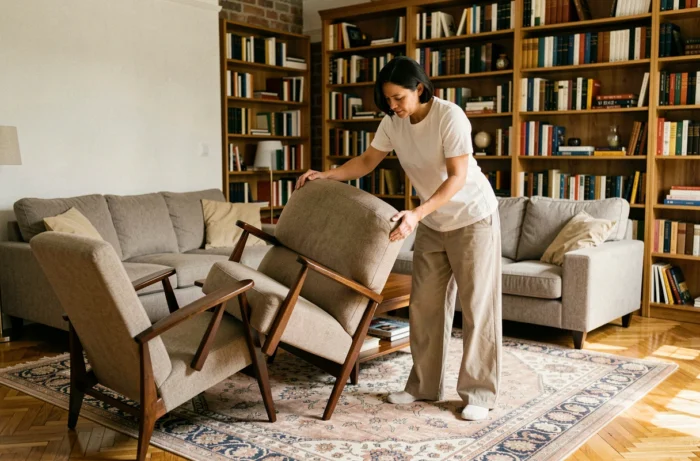
Before buying anything, try moving your sofa. Pushing it against the wall is a common reflex, but positioning it in an island facing a focal point (fireplace, bookshelf, window) creates a more intimate conversation space.
Leave a passage of at least sixty centimeters behind the sofa to keep the flow smooth.
16. Add a strategic mirror
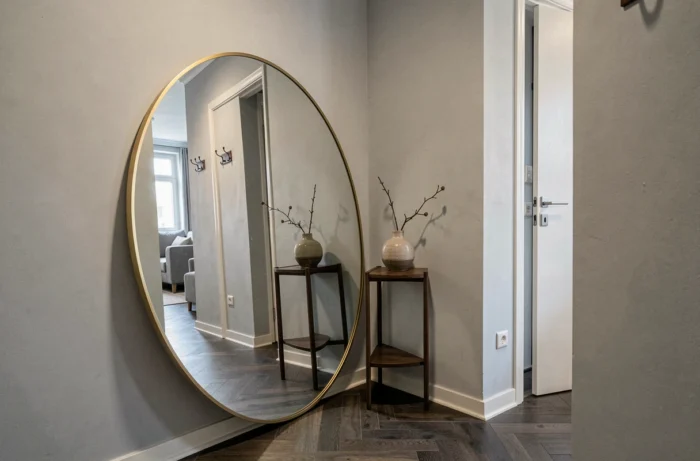
A large mirror placed on the floor or hung opposite a window doubles the perceived natural light. In a north-facing room, this is one of the most effective gestures.
Opt for a simple frame, in wood or thin metal, so that the mirror blends into the decor rather than dominating it.
17. Organize objects by visual family
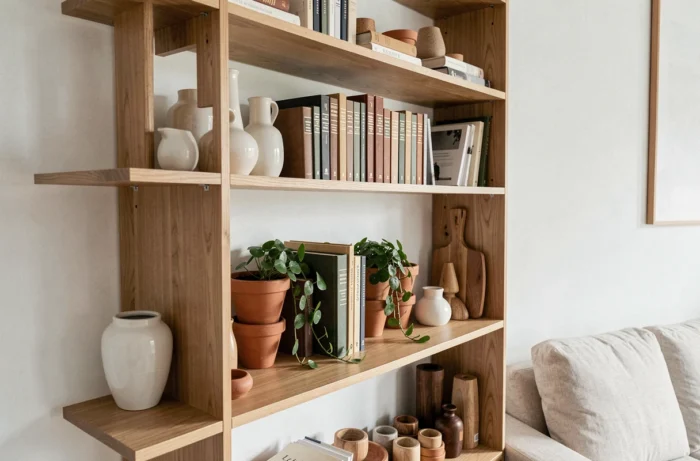
On a shelf or open buffet, group objects by material or color rather than by function. All ceramic items together, all light-covered books side by side.
This visual sorting transforms a heterogeneous collection into an organized composition. You can do this in ten minutes with what you already have.
18. Incorporate artisanal ceramics
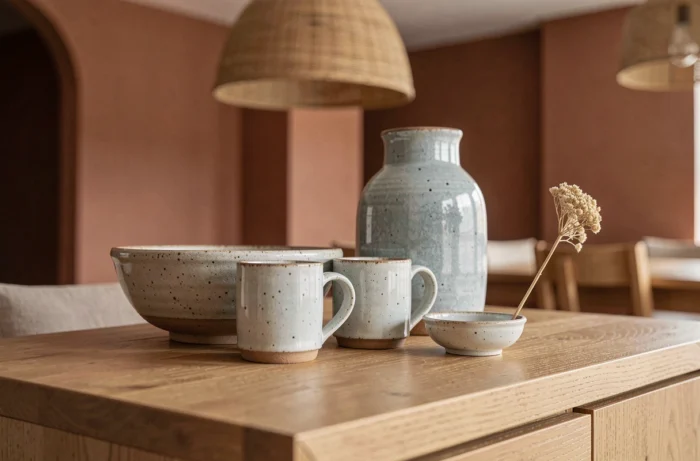
A vase, dish, or bowl made by a ceramist brings a welcome irregularity to a very geometric interior. The artisan’s hand is visible, and that’s what adds warmth.
Several French ceramists, from Provence to Brittany, offer accessible pieces that age beautifully over time.
19. Work on the color palette room by room
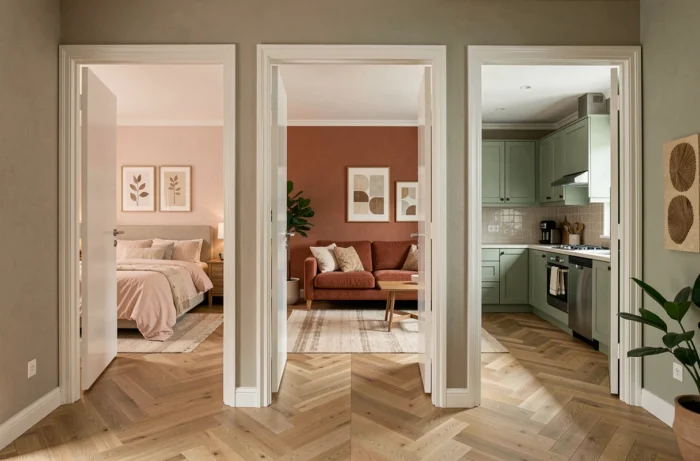
Instead of choosing a single color for the entire house, define a palette of three shades per room: a dominant (walls, floor), a secondary (furniture, curtains), and an accent (cushions, objects).
This method avoids taste mistakes and allows for varying atmospheres from one room to another while maintaining coherence as you move through the house.
20. Declutter before decorating
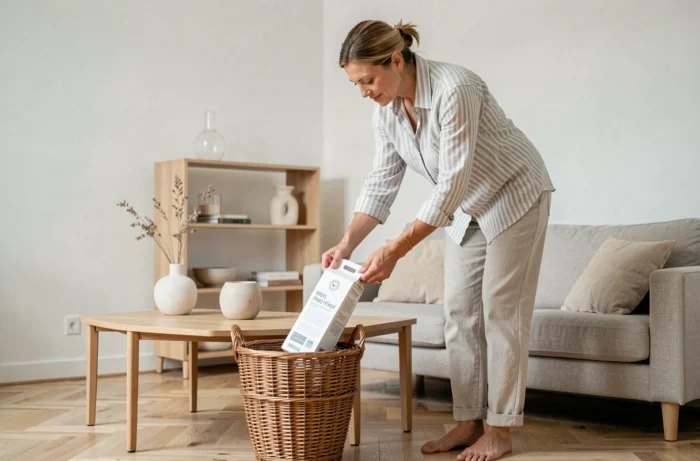
This is often the most neglected gesture. Removing excess items, unused furniture, and accumulated knick-knacks frees up visual space. Decoration that supports the architecture works better in a lightened setting.
The free pickup of old furniture by retailers, made possible by the AGEC law, facilitates this step. You can gradually renew your interior without storing bulky items.
Each idea listed here works on its own, but combining two or three gestures in the same room produces a visible change. The common thread among all of them: they rely more on observing your space than on a substantial budget.