
The STMG characterization table is based on about ten criteria that seem simple to fill out. The majority of papers lose points not due to gaps in knowledge, but because of confusions regarding the scope between the legal entity and its brand, or due to formulations that are too vague to be evaluated.
Scope of the organization: subsidiary, brand, or group
We observe that the most underestimated error concerns the exact scope of the organization being studied. An exam topic often mentions a commercial brand or a trademark. The student then fills in the commercial name in the “name” box, the group’s workforce in the “size” box, and the consolidated revenue in the “resources” box.
The problem: a subsidiary and its group do not have the same legal status or the same indicators. A franchised fast-food brand may be a SAS with ten employees, while the group that owns the brand is a publicly traded SA employing several thousand people. Filling in the group’s data when the topic is about a local point of sale distorts nearly all the criteria of the table.
We recommend that before filling in any box, the student precisely identify the entity targeted by the topic. The business directory, managed by the Interministerial Digital Directorate, allows verification of the corporate name, legal form, and declared workforce of a given structure. This type of cross-checking is what the examiners expect when reading the responses related to the STMG characterization table on Direct Emploi, and it distinguishes a rigorous paper from an approximate one.

Legal status and sector of activity STMG: two criteria that papers merge
Writing “private” or “public” in the legal status box is the most common and most penalized response. The legal status refers to the legal form of the organization: SA, SAS, SARL, EURL, 1901 law association, EPIC. The distinction between public/private pertains to the sector, not the status.
INSEE explicitly separates the legal category, the main activity carried out, and the sector of activity. A 1901 law association can operate in the commercial sector. An EPIC is a public establishment that carries out industrial and commercial activities. Reducing these realities to “private” or “public” ignores the framework of the program.
How to correctly formulate the status
The examiner expects the precise legal form, not a general category. Here’s what we recommend checking before completing this box:
- Identify the legal form mentioned in the topic or annexes (SA, SAS, SARL, 1901 law association, etc.) and copy it exactly
- Do not deduce the status from the sector of activity: a public service company can be a SA with public capital
- Specify, when the information is available, whether the organization falls under private or public law, but as a complement to the status, never in its place
Profit motive and non-profit motive: the trap of vague reformulation
“Making money” is the formulation that appears in the majority of papers to describe the purpose of a private company. The program expects the term “profit motive” associated with the pursuit of profit, or “non-profit motive” for organizations whose main objective is the general interest or public service.
The confusion worsens with hybrid organizations. An association that sells services (training, consulting) generates revenue, but its purpose remains non-profit if the surpluses are reinvested in the social object. We find that many students write “lucrative” as soon as they identify a commercial activity, without verifying the destination of the profits.
Purpose and resources: two linked but distinct boxes
Another recurring error: confusing purpose with resources. Revenue is a financial resource, not a purpose. The purpose answers the question “why does this organization exist?”, while the resources answer “what does it operate with?”.
When the topic concerns an administration, the purpose is public service. When it concerns a mutual, the purpose is the protection of members. Each type of organization has a specific purpose that cannot be summarized in one word.
Resources of the characterization table: the systematic omission of intangible assets
Papers almost always mention human resources (employee count) and financial resources (revenue, capital). Material resources (premises, machines, vehicles) appear in about half of the cases. In contrast, intangible resources are absent from the majority of tables.
The management and business program explicitly includes patents, trademarks, licenses, know-how, customer databases, and reputation in intangible resources. Ignoring this category results in losing points on a criterion that is clearly stated in the reference framework.
- Patents and licenses: check in the annexes if the organization holds intellectual property rights
- Brand and reputation: mention the brand as an intangible resource when it constitutes an identifiable competitive advantage
- Information system: business software, databases, and algorithms are intangible resources in their own right
- Know-how: technical skills not formalized in a patent but transmitted within the organization
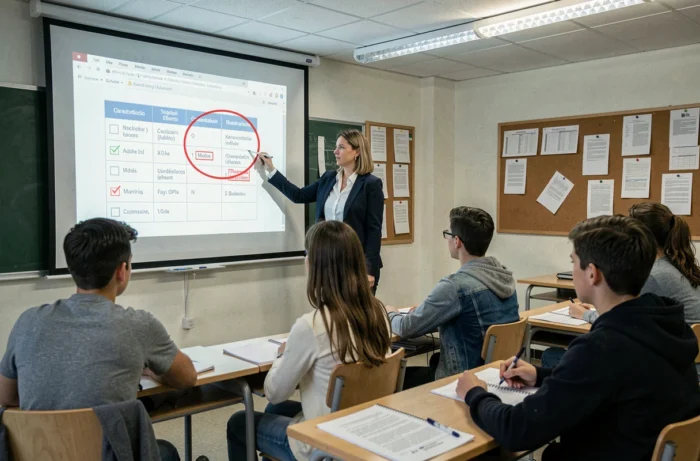
Size of the organization in STMG: justify the category with an indicator
Writing “large company” or “SME” without an indicator is an incomplete response. The examiner expects a measurable criterion: employee count, revenue, or total balance sheet. The category alone, without the indicator that substantiates it, earns only a fraction of the points.
We also observe confusion between size and influence. A start-up with a few employees can have international reach thanks to a digital platform, but it remains a micro-enterprise or a small business in terms of classification thresholds. Size is determined by quantitative criteria, not by geographical extent.
The STMG characterization table penalizes approximations more than outright errors. A paper that writes “SAS” instead of “SARL” loses a point; a paper that writes “private company” instead of the precise legal status shows that it has not understood the framework. Each box of the table corresponds to targeted course vocabulary, and it is the terminological precision, more than completeness, that makes the difference on exam day.