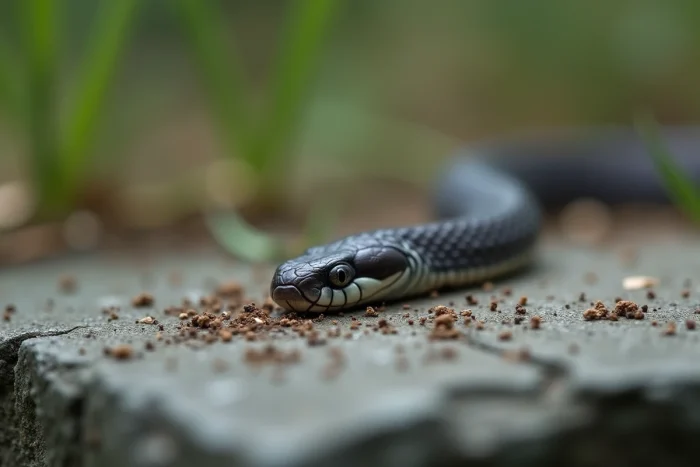
It is rare to come across a grass snake in action in a massif or under a slab. What you often find, however, is a small dark deposit on the terrace, at the foot of a wall, or between two flower pots. This grass snake droppings often go unnoticed, confused with bird droppings or rodent excrement. Learning to distinguish it, however, provides a direct insight into what lives, hunts, and circulates in your garden.
Appearance and texture of grass snake droppings: what distinguishes it from other excrements
Grass snake droppings have an elongated shape, sometimes slightly twisted. Their color ranges from dark brown to black, with a particular feature that greatly aids in identification: a white or whitish tip at one end. This light part corresponds to uric acid, the equivalent of urine in reptiles, expelled at the same time as feces through a single opening called the cloaca.
The size depends on the species and age of the snake. You can find droppings a few centimeters long for a juvenile grass snake, up to larger portions for an adult. When observed closely, you may sometimes spot undigested remains: small bones, lizard scales, fragments of insect shells, or even rodent fur.
It is this composition that makes all the difference from other droppings. Bird droppings are more liquid and do not contain fur or bones. A marten’s droppings are more cylindrical, often deposited at height, and emit a pronounced musky odor. Hedgehog droppings, on the other hand, are more rounded, black, and shiny. If in doubt, the simultaneous presence of the white tip and visible food debris strongly indicates a snake.
To identify grass snake droppings with certainty, you can also note the exact location where it was found: grass snakes often defecate in resting areas (warm stones, compost, wall edges), not in the middle of the lawn.

Grass snake droppings and diet: an X-ray of the local fauna
Each excrement tells the story of the last meal. And this meal reveals a lot about what lives around your home.
Rodent fur in droppings
Fur, a tiny jaw fragment, sometimes a claw: the grass snake actively hunts voles, field mice, and young rats. Finding these remains indicates an active rodent population in the garden. The grass snake naturally regulates these species which, without a predator, can damage roots, bulbs, and buried cables.
Fragments of insects or amphibians
Shards of beetle shells or small fine translucent bones signal the presence of frogs, toads, or large insects. This type of diet indicates a moist garden, with water points or shaded areas favorable to amphibians. The diversity of these remains in the droppings directly reflects the richness of soil biodiversity and the lower strata.
Lizard scales
Some grass snakes, like the green and yellow grass snake, feed on lizards. Finding fine scales in their droppings confirms the presence of smaller reptiles, a sign of a dry and sunny environment with well-exposed walls or piles of stones.
Grass snake in the garden: what its presence signals about the ecosystem
The reasoning can be summarized simply: no prey, no grass snake. Its presence is a reliable indicator of an ecologically functioning garden, with several links in the food chain in place.
- A living soil, rich in invertebrates, that attracts small predators (shrews, lizards)
- A sufficient rodent population to feed a higher-ranking predator like the grass snake
- Diverse natural shelters (compost, dead wood, stones, dense hedges) that serve as refuge for all this fauna
Where things get complicated is when chemical rodenticides are still used to combat rodents. ANSES has documented the risk of secondary poisoning for non-target wildlife, including snakes. A grass snake that consumes a vole poisoned by an anticoagulant absorbs the poison in turn. Finding grass snake droppings in a chemically treated garden should prompt a review of this practice: the snake does the job for free and without residues.
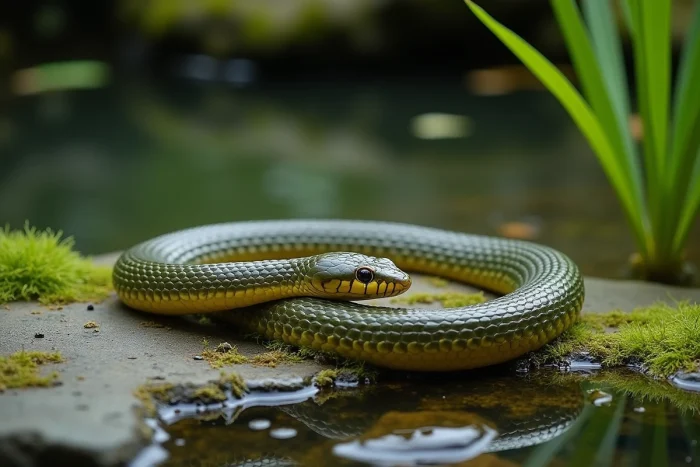
Reporting and documenting snake traces in your garden
For several years, participatory monitoring of reptiles has been organized in France. The INPN Espèces platform, managed by the National Museum of Natural History, allows for reporting observations of grass snakes and their traces. Regional herpetological networks, including the Société Herpétologique de France (SHF), use this data to map the distribution of species even in private gardens.
Specifically, a photo of the excrement with an object for scale (coin, pen), the GPS location, and the date are enough to contribute. This type of reporting helps track the evolution of grass snake populations at the local level, especially in peri-urban areas where habitats are fragmented.
For the gardener, documenting these findings over the seasons also allows for spotting habits: recurrent passage areas, activity periods, dominant prey types. It creates a sort of biodiversity logbook for the land, much more informative than a simple one-time visual inventory.
All grass snakes present in mainland France are protected species. Capturing, moving, or killing them is prohibited by law. Their presence does not require any intervention: they are not dangerous to humans and flee at the slightest contact. The best approach is to maintain the conditions that suit them (hedge, compost, wood piles) and to consider each droppings found as proof that the garden fulfills its role as a functional ecosystem.