
A fridge that signals an expired yogurt, glasses that display a notification in the field of vision, a European regulation that governs all this: we are no longer talking about showroom prototypes, but about products that are hitting the shelves. The high-tech innovations of 2024 are not just a race for power. They change the way we interact with our devices, how we monitor our health, and how the law protects our data.
AI Act and transparency obligations: what the European regulation 2024/1689 changes
When we buy a voice assistant or use a customer service chatbot, we don’t always know that artificial intelligence is processing our requests. The European regulation 2024/1689, which came into effect on August 1, 2024, gradually imposes the need to correct this opacity.
Since February 2, 2025, certain AI practices deemed unacceptable are prohibited, and AI literacy obligations apply to the relevant organizations. In practical terms, a company deploying a chatbot must ensure that its teams understand how the system works and its limitations.
The transparency obligations of Article 50 apply since August 2, 2026. This means that AI-generated content (texts, images, sounds) must be identified as such to the user. You can find regular updates on these regulatory developments and their impact on consumer products in the tech news on Web Hebdo.
This framework goes beyond mere administrative formality. It conditions the marketing of many connected devices and changes manufacturers’ practices well beyond French borders.

AI assistants integrated into devices: beyond the marketing gadget
At CES 2024, most manufacturers presented devices that integrate artificial intelligence directly into the hardware. We are no longer talking about a remote assistant in the cloud, but about dedicated chips embedded in smartphones, laptops, and even home appliances.
Real-time translation and connected refrigerators
Smartphones capable of translating a phone call into a foreign language in real-time were showcased. Refrigerators detect foods nearing their expiration date and suggest recipes. Embedded AI processes data locally, without going through a remote server.
This local processing has a direct advantage: latency decreases, and personal data remains on the device. Feedback on this point varies by brand and model, but the underlying trend is clear.
Rabbit R1 and the post-smartphone question
The Rabbit R1, unveiled at CES 2024, offers a different approach. This compact device uses an AI model to perform actions on behalf of the user (booking a restaurant, ordering a taxi) without going through individual applications.
The idea is to replace navigating between ten applications with a single conversation with an assistant. In practice, the product targets a specific use: reducing the time spent juggling between interfaces. Its relevance will depend on the robustness of its model in handling complex requests.
Connected health and home diagnostics: devices that change medical monitoring
The BeamO, presented by Withings, combines four diagnostic functions into a single device usable at home:
- Infrared body temperature measurement, contactless
- Single-lead electrocardiogram to detect irregularities in heart rhythm
- Oximeter to monitor blood oxygen saturation
- Digital stethoscope allowing the recording of lung sounds and transmitting them to a doctor
A basic health assessment achievable in a few minutes without leaving home is the positioning of this type of device. For people in rural areas or with reduced mobility, the benefit is tangible: fewer trips for a first level of monitoring.
At CES 2025, the connected mirror Omnia pushed the concept further by analyzing health parameters through simple reflection. We move from an object that is taken out of a drawer to an object that is used without thinking, integrated into the furniture.
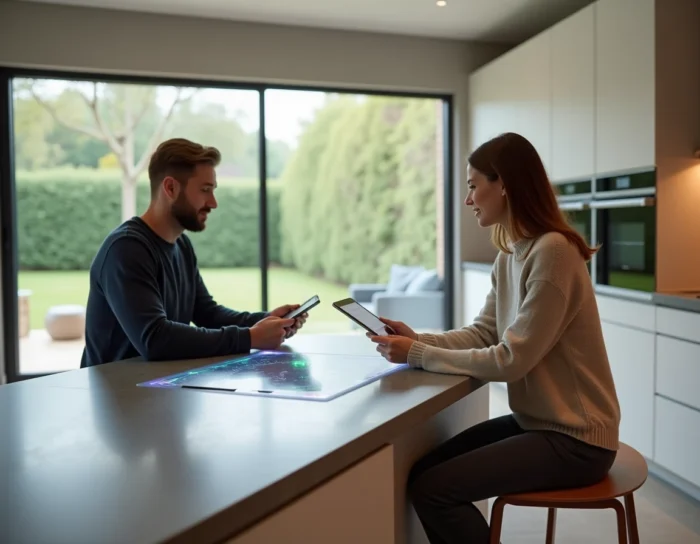
Transparent screens and connected glasses: interfaces that blend into the decor
LG unveiled a transparent OLED TV at CES 2024. When off, the screen looks like a window. When on, it displays an image without an opaque background. The most immediate application concerns interior design: a screen that no longer monopolizes an entire wall.
The Halliday connected glasses, presented at CES 2025, project a screen directly into the user’s field of vision. Unlike virtual reality headsets, they do not cut off from the outside world. You read a notification, check a route, without taking out your phone.
The interface disappears from the hand to come closer to the gaze. This evolution raises practical questions (battery life, comfort over an entire day) and regulatory issues, particularly regarding the transparency obligations of the AI Act when these glasses incorporate AI functions.
Preparing users, not just products
Articles dedicated to the innovations of 2024 detail the features of the devices but rarely touch on one point: the preparation of users and companies for these new uses. The AI Act explicitly provides for “AI literacy” obligations, reflecting a growing awareness at the European level.
You can buy a connected fridge or a home diagnostic device. However, it is essential to understand what AI does with our data, under what conditions its recommendations are reliable, and when human judgment remains necessary.
- Check if a connected device processes data locally or sends it to a remote server
- Ensure that the manufacturer specifies the limitations of its algorithms (a consumer oximeter does not replace a complete medical assessment)
- Consult updates on the European regulatory framework, whose obligations evolve in stages until 2027
The high-tech innovations of 2024 are not limited to a technological showcase. They come with a legal framework that structures their deployment and a shared responsibility between manufacturers and users. The most advanced product remains useless if we do not know under what conditions to trust it.